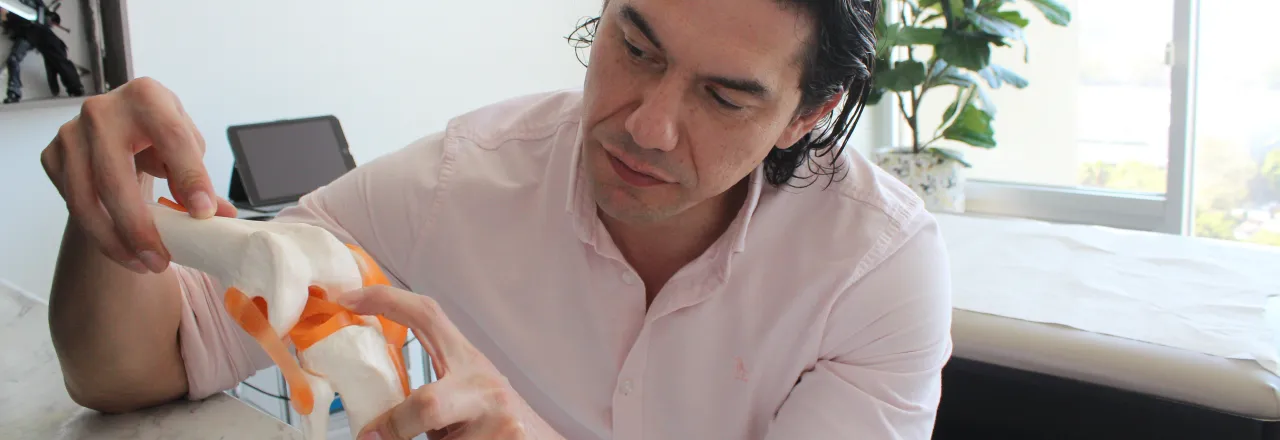
You've probably seen videos where someone suffers a shoulder or elbow dislocation and then a healthcare professional 'pops it back' into place. This procedure is the reduction of a dislocation, a serious injury that I'd like to explain as an orthopedic surgeon in Tijuana. My goal is to clearly explain what they are, their symptoms, how they're treated, and most importantly, when they constitute a medical emergency.
What exactly is a dislocation?
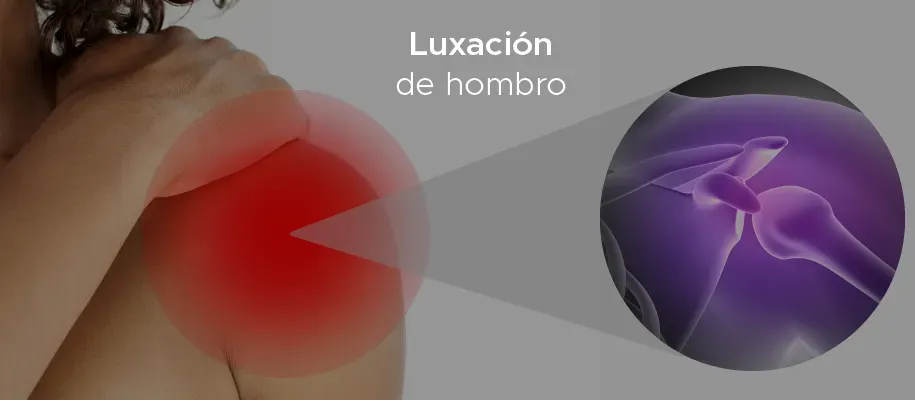
A dislocation occurs when an extreme force displaces the bones that form a joint, causing them to lose their normal alignment.
A joint is composed of bone surfaces covered with cartilage, joint capsules, ligaments, and synovial fluid. Imagine they function as a perfect gear working in harmony, but dislocation disassembles this gear.
Simple and Complex Dislocations?
We call it a simple dislocation when there is no fracture and complex when it generates a fracture and considerable instability.
The most frequently affected joints are, first, the shoulder, followed by the elbow, being more common in men. These are followed by dislocations of the knee, hip, and fingers.
Types of Dislocations
1. By cause:
Traumatic: The most common. Result of a direct impact, fall, or accident.
Congenital: Due to abnormalities present at birth, such as hip dysplasia.
Pathological: Due to diseases that weaken joints, such as rheumatoid arthritis.
Recurrent instability: Sequel of a previous injury that left the joint vulnerable.
2. By direction of displacement:
Anterior: The bone moves forward (example: anterior shoulder dislocation is the most common).
Posterior: The bone moves backward (example: posterior hip dislocation, often from a car accident).
Inferior/Superior: Less common, but usually serious because they can critically compress nerves or blood vessels, requiring immediate attention.
Subluxation: A partial dislocation. The bones separate but not completely, and usually return to position spontaneously.
Common Symptoms of a Dislocation
How to identify?
Intense, sharp pain that worsens with movement.
Visible deformity or swelling in the area.
Total or partial inability to move the joint.
Numbness, tingling, or loss of sensation (sign of possible nerve injury).
Bruising and warmth sensation in the area.
When is it a medical emergency?
A dislocation is always an emergency that requires immediate medical evaluation. Time is a vital factor to prevent complications. Go to the emergency room or an orthopedic center immediately if, in addition to the previous symptoms, the following occur:
Loss of pulse below the injury (hand, foot).
Pale, cold, or bluish skin.
Severe loss of sensation or paralysis.
An open wound near the dislocated joint.
First Aid: What to Do and What to Avoid
What to do:
Stay calm and call emergency services or take the person to a hospital.
Immobilize the area as it is. Do not attempt to move it.
Apply ice wrapped in a cloth to reduce swelling and pain.
What to avoid:
Do not attempt to readjust the joint - incorrect manipulation can cause severe damage to nerves, blood vessels, or worsen a fracture.
Do not massage the area or apply heat.
Diagnosis in Orthopedic Consultation
Diagnosis involves:
Physical evaluation: We check circulation, nerve function, and the extent of damage.
Imaging studies:
X-rays: Essential to confirm the dislocation and rule out fractures.
MRI or CT Scan: To evaluate damage to ligaments, cartilage, or more complex injuries.
When is surgery necessary for a dislocation?
Blood vessel injuries: A hip or knee dislocation can interrupt blood flow to the leg. Therefore, leg tissues cannot get enough blood (called ischemia) and may die (called necrosis). A dislocated hip is prone to necrosis, especially if the dislocation is not reduced quickly. Certain elbow injuries can interrupt blood flow to the forearm, causing similar problems.
Hemorrhage: Severe or traumatic dislocations can damage surrounding tissues and cause internal bleeding. A dislocated bone can pierce the skin and cause external bleeding.
Nerve injury: Sometimes nerves are stretched, injured, or crushed when a joint is dislocated. Direct trauma can bruise or crush a nerve. Crushing causes more significant injury than bruising and may require surgical repair.
Conservative Treatment
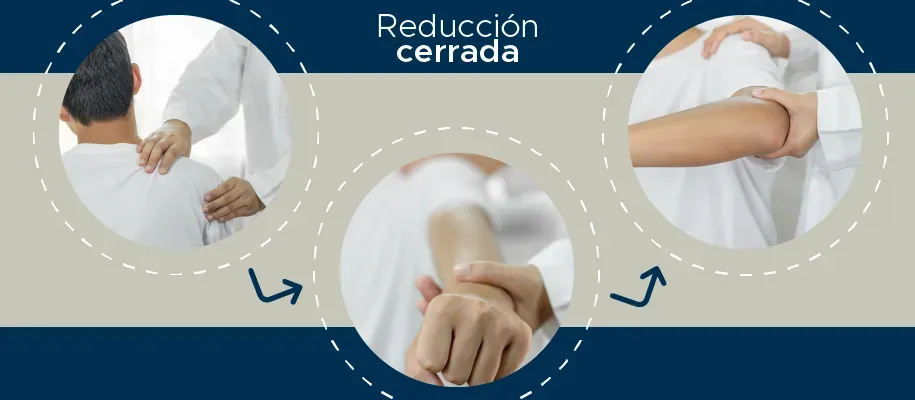
The main treatment is closed reduction, which consists of gently manipulating the joint to return the bones to their anatomical position.
This procedure:
Must be performed exclusively by a physician.
Is usually performed under sedation or local anesthesia to minimize pain and muscle tension.
Specific traction and counter-traction techniques are used. There are outdated techniques and new techniques that allow for an ideal reduction and immobilization for a speedy recovery, although this will depend on each case and the patient's overall health status.
Recovery and Rehabilitation: The Role of Physical Therapy
Immobilization is only the first phase. Physical therapy is fundamental for a complete recovery. We follow the PRICE protocol in the initial phases and then progress to specific exercises:
Protection: Use of splints.
Rest: Avoid risk activities.
Ice: To control inflammation.
Compression: With elastic bandages.
Elevation: To drain fluid and reduce swelling.
Physical therapy focuses on:
Recovering range of motion.
Strengthening the muscles surrounding the joint to provide stability.
Preventing future injuries.
The knee, elbow, and shoulder are particularly prone to developing stiffness after a dislocation, especially in older people, which is why a comprehensive approach to recovery is essential to prevent stiffness and help the joint move as normally as possible.
A dislocation is more than just a 'bone out of place' that needs to be 'put back'. It is a complex injury that can become serious and compromise the integrity of the joint and even the patient's life. Timely diagnosis by a specialist orthopedic surgeon is essential.
If you or a family member have suffered an injury and are seeking a second opinion, I would be happy to support you with an approach or diagnosis to ensure an optimal recovery or treatment plan that minimizes the risk of complications and restores optimal health and independence.
I invite you to write to me, send me a message, or follow me on my social media to learn more about injuries, pathologies, and orthopedics and traumatology tips.
I am located in Tijuana near you in Zona Río, just minutes from the border.
Among the conditions and treatments I address are: Joint pain or osteoarthritis, hip and knee replacements, spinal problems such as herniated discs and degeneration, fracture treatment, sprains, and sports injuries through conservative treatment or surgery, and knee and shoulder arthroscopy.
No hay comentarios para este blog.