Did you fall, have an accident, or suffer a complex bone fracture?
Osteosynthesis is the technical name for the surgery that aims to achieve stabilization and union of a bone that has suffered a fracture.
What exactly is osteosynthesis for?
Let's imagine we're building the foundation for a second floor - we need it to be well-aligned and support the load. In this case, materials like plates, screws, and nails will function as support and foundation for your body so the bone can heal and consolidate.
Osteosynthesis materials can be titanium alloys and stainless steel.
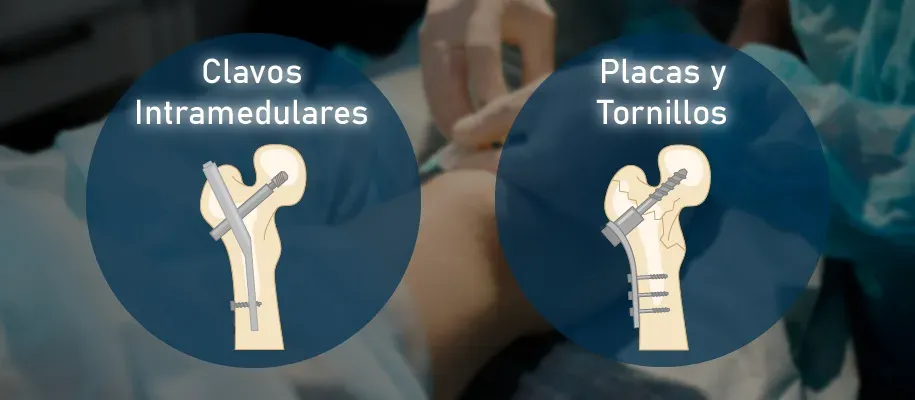
There are different instruments for osteosynthesis:
Intramedullary Nails: These are metal rods that go inside the bone (in the center, like a post), very common in femur and tibia fractures.
Plates and Screws: Used mainly in fractures near joints.
Are all screws used in fractures the same?
There are multiple types including:
- Compression screw: used to firmly join two bone parts, applying slight pressure that helps their consolidation.
- Fully threaded screw: fixes two pieces (for example, bone with bone or with a plate), but without exerting pressure between them.
- Syndesmotic screw: used mainly in the ankle, to stabilize the union between the tibia and fibula after an injury or fracture.
- Cannulated screw: has an internal hole that allows more precise placement, guided by a thin wire. Common in hip or femoral neck surgeries.
- Anchor screws (metal anchors): used to fix injured tendons or ligaments to the bone. They have hooks or points that facilitate their grip.
- Interference screws: used in anterior cruciate ligament (ACL) reconstructions to maintain the graft in place within the bone.
- Dynamic hip screw (DHS): used in fractures of the upper femur (hip). Its design allows the bone to adjust as it heals.
- Dynamic compression screws (DCS): thicker and more resistant, designed for fractures near the knee or hip.
Plates:
Plates are metal sheets (steel or titanium) that are placed over the bone and secured with screws. They are used to maintain the fragments of a fracture in place while the bone heals.
- Compression plates: help join the ends of the bone by applying pressure, ideal for stable fractures.
- Dynamic compression plates (DCP): have special holes that allow adjusting the pressure on the fracture.
- Low contact plates (LCP): a more modern version; their design allows better blood flow in the bone, favoring recovery.
These plates are used mainly in fractures of long bones like the femur, humerus, or radius, and also in some spine or wrist surgeries.
Intramedullary nails:
Nails are metal bars that are placed inside the bone canal (like an internal rod). They are used in fractures of long bones like the femur, tibia, or humerus and offer excellent stability.
They are placed through small incisions, without needing to completely expose the bone. These devices allow for earlier recovery and reduce damage to the tissues surrounding the bone.
Monitoring Your Recovery: How do I know if I'm healing well?
Bone healing is a complex process that has several stages, from the formation of soft callus to the final welding and remodeling. There are two criteria to know if you're on the right track:
Less Pain: Pain should decrease consistently. One of the most important signs that the process is progressing well is a reduction in pain. Persistent pain, especially when supporting or moving, can be a warning sign.
Functional Recovery: Noticing that you can move the limb or support weight (if your doctor authorized it) better and better is a great indicator of progress.
No Persistent Inflammation: The absence of excessive and persistent heat or swelling in the area is a good sign that there are no complications.
During this process it's important to periodically get X-rays to confirm progress. The goal is to see the fracture line and how a bridge of new bone is being generated.
Delay or pseudoarthrosis?
We call it delay when the healing time is notably exceeded, but the process hasn't completely stopped yet. Radiographically, the bone edges appear 'clean'. In these cases, prolonging rest or dynamization of the nail can reactivate the process.
Cases in which it will be necessary to perform removal of osteosynthesis material
- Infection: In case of a deep infection it's preferable to remove the material, since microbes form hiding places where antibiotics cannot reach them.
- Discomfort: if the material remains very superficial or near a joint it can cause discomfort or pain, so it's essential to remove it.
- Practicing extreme sports: being people with high risk of suffering new fractures, if this occurs in a limb that already has a previous nail, it's very difficult to operate.
- Growth: in the case of growing patients it's better to remove it. This is because the bone can envelop the nail or screw preventing its extraction.
Vicious consolidation
We call it vicious consolidation when the bone has healed, but not in the correct anatomical or biomechanical way, due to a problem of length, angulation, or rotation. In this case, surgery is required to correct the deformity and improve pain.
Pseudoarthrosis
In cases of pseudoarthrosis, it's the most serious diagnosis, as it indicates that the bone healing process has completely stopped. This is usually confirmed when at least nine months have passed since the fracture without evidence of consolidation.
On X-rays, the bone ends may appear hardened (sclerotic) or even reabsorbed.
Treatment depends on the type of pseudoarthrosis:
- Hypertrophic pseudoarthrosis: The initial approach is to treat any infection that may be present.
- Atrophic pseudoarthrosis: It's necessary to remove the fibrous or damaged tissue until healthy bone is exposed. In these cases, bone grafts may be used, whether autografts (such as from the patient's own iliac crest) or donor grafts, and even new fixation through osteosynthesis to favor bone regeneration and stability.
Rejection of osteosynthesis material
These are multifactorial causes that can lead to osteosynthesis failure, not necessarily that the body rejects the material, but that there was extensive material fatigue that generated overload and stress.
If rest measures, relative rest, and postoperative and rehabilitation care are not followed to the letter, they can compromise the osteosynthesis process.
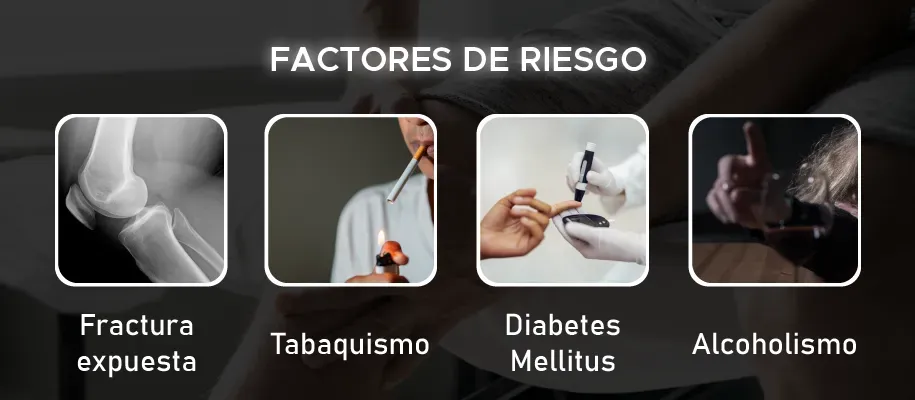
Risk factors:
- Open fractures: due to greater exposure and therefore greater contamination, predisposes to late complications during the consolidation process.
- Smoking: Smoking reduces your body's ability to form callus. Nicotine and other substances inhibit osteoblasts, which are the specialized cells that build new bone.
- Diabetes mellitus: Especially if not well controlled, it's an important metabolic risk factor, due to microvascular damage, which is a key factor for bone consolidation.
- Alcoholism: favoring the production of osteoclasts that basically generate bone resorption, delaying consolidation.
Reasons why your plate and screws fail or 'don't stick'
Mechanical failures: can be seen on X-ray as abundant callus, what the body wants to heal is the unstable screw, plate, or nail. This instability generates excessive movement or stress that prevents the bones from consolidating.
Biological failures: can be seen on X-ray as little or no callus, the body doesn't have the capacity to generate bone, due to poor circulation or an infection.
Has my fracture healed? Is it necessary to remove the plates and screws?
When the bone has completely consolidated—generally between 9 and 12 months, depending on the type of fracture—the fixation material has fulfilled its function and can be removed. This procedure is known as Removal of Osteosynthesis Material (ROM). However, it's not always mandatory; it will depend on the fracture, the type of material used, and the patient's evolution.
Important considerations
After removal, it will be necessary to follow care similar to the first surgery, to ensure adequate recovery without complications.
In the case of the spine, when an arthrodesis (vertebral fusion) is performed and the implants are left in place, adjacent segment disease may occur over time. This happens because when the operated area becomes rigid, the nearby vertebrae assume more load and movement, which can accelerate their wear.
Selection of osteosynthesis material:
The choice of the type of osteosynthesis should be made carefully considering factors such as the patient's age, the complexity of the fracture, the condition of the tissues, and the material's ability to adequately transmit loads to the recovering bone.
Remember that osteosynthesis provides mechanical stability, but it's your body that performs the true healing. Therefore, it's essential to maintain constant follow-up with your traumatologist and physiotherapist to avoid complications like pseudoarthrosis.
Adopting healthy habits, avoiding alcohol and tobacco consumption, and taking care of your general well-being will help your body heal faster and effectively.
Recovery is a process, not a race. Be patient and don't hesitate to ask any concerns you have; your traumatologist will accompany you throughout the recovery process.
If you have suffered a fracture and notice that you're not improving, or have doubts about whether it's a vicious consolidation, delayed consolidation, or pseudoarthrosis, I invite you to schedule a consultation for evaluation. Together we can analyze your case and design a personalized treatment plan.
I'm located in Tijuana, Baja California, and also offer online consultations for patients from other states.
If you have any questions or comments, you can write them or schedule your appointment directly.
No hay comentarios para este blog.